Ham Radio Repeaters
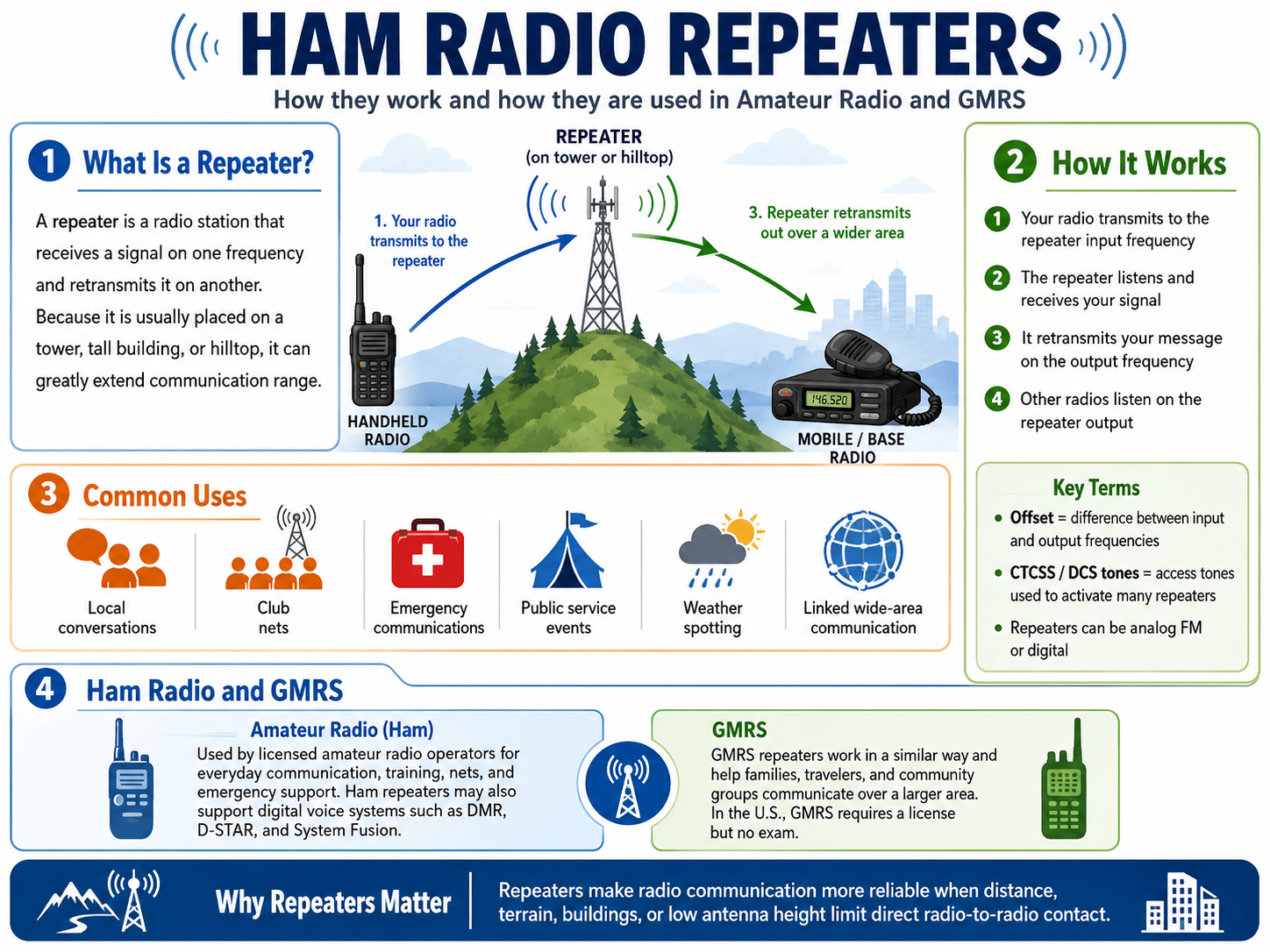
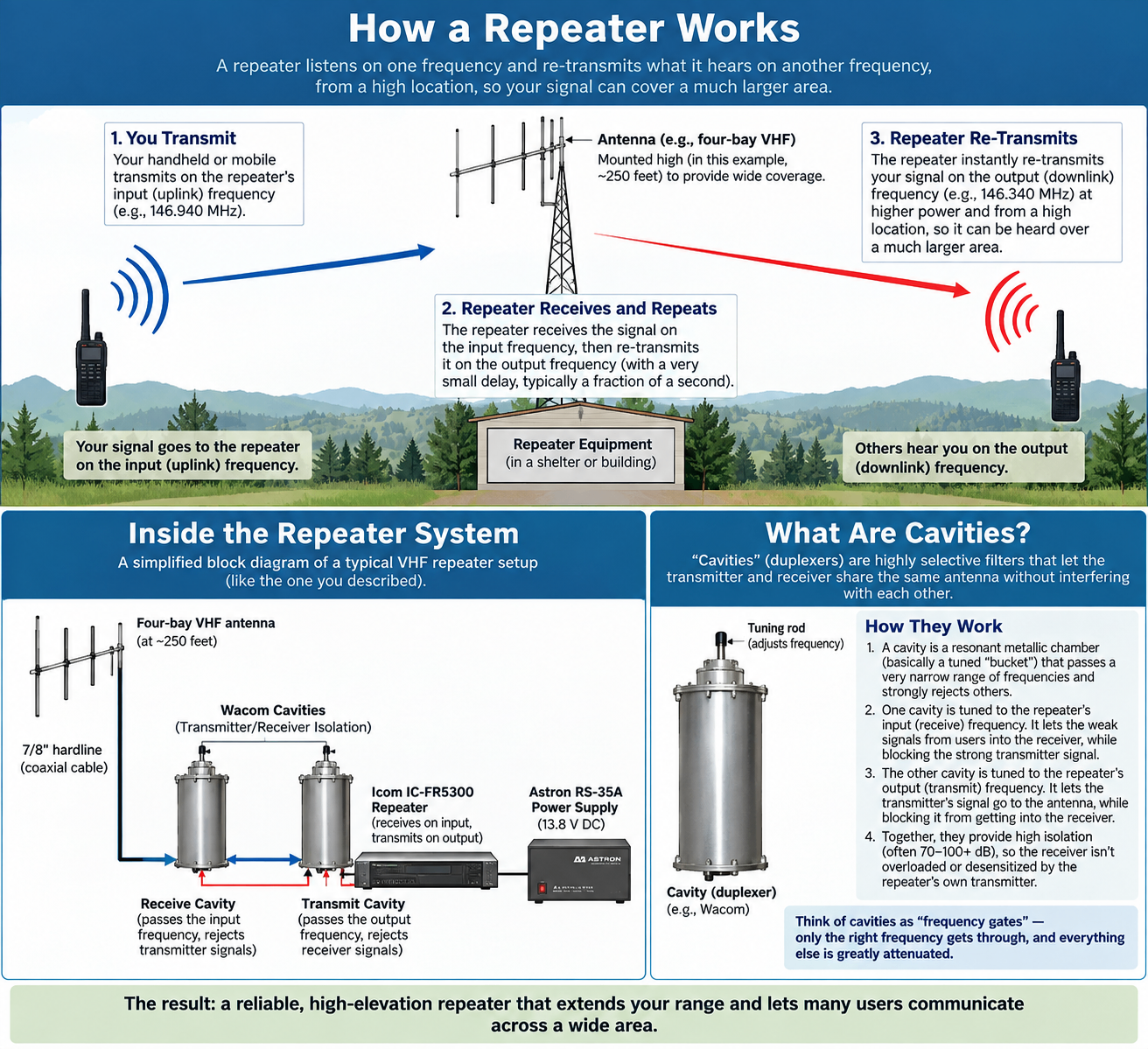
Amateur radio repeaters are stations designed to receive a radio signal on one frequency and retransmit it on another. Because repeaters are often installed on towers, tall buildings, or mountaintops, they can greatly extend the useful range of handheld and mobile radios. A signal that might normally travel only a few miles can sometimes reach across an entire county or region through a well-positioned repeater.
A repeater operates with two frequencies: an input frequency and an output frequency. The user’s radio transmits on the repeater’s input frequency and listens on its output frequency. This difference is called the **offset**. Most repeaters also require a CTCSS tone, DCS code, or digital access code to prevent unwanted signals from activating the system. Repeaters may be analog FM, or they may use digital systems such as DMR, D-STAR, or System Fusion.
In amateur radio, repeaters are commonly used for local conversations, emergency communications, public-service events, weather spotting, and radio-club activities. Many repeaters carry scheduled nets where operators check in, share information, practice emergency procedures, or discuss technical topics. Some repeaters are linked together through radio or the internet, allowing operators to communicate over much greater distances.
GMRS repeaters work in much the same way, using separate transmit and receive frequencies to extend the range of licensed GMRS radios. They are often used by families, community groups, travelers, and emergency-preparedness organizations. Unlike amateur radio, GMRS does not require an examination, but a license is required in the United States. Whether used on amateur radio or GMRS, repeaters provide reliable local and regional communication when direct radio-to-radio contact is limited by distance, terrain, buildings, or antenna height.